At the same time, India has become a well-established global hub for accounting and financial
services. According to industry data, over 90% of Fortune 500 companies use India for finance
and accounting functions, driven by access to skilled professionals and scalable delivery
capacity. This makes India a natural choice for firms looking to hire accounting teams in India
rather than stretch already constrained onshore teams.
The challenge, however, is not access to talent, but execution. Hiring directly in India exposes
firms to India hiring compliance for accounting firms, including unfamiliar labour laws,
payroll regulations, and statutory obligations. Without the right structure, these complexities can
create legal, financial, and reputational risk.
Employer of Record (EOR) Servicesaddress this gap by providing a compliant employment
framework that allows accounting firms to build dedicated teams in India while keeping
employment, payroll, and labour law risk under control.
In this blog, we explore how Employer of Record services work, what they cover, why they are
particularly suited to accounting firms, the real risks of hiring in India without an EOR, and how
working with the right EOR partner supports confident, compliant scale.
What Is an Employer of Record (EOR) and What Does It Cover?
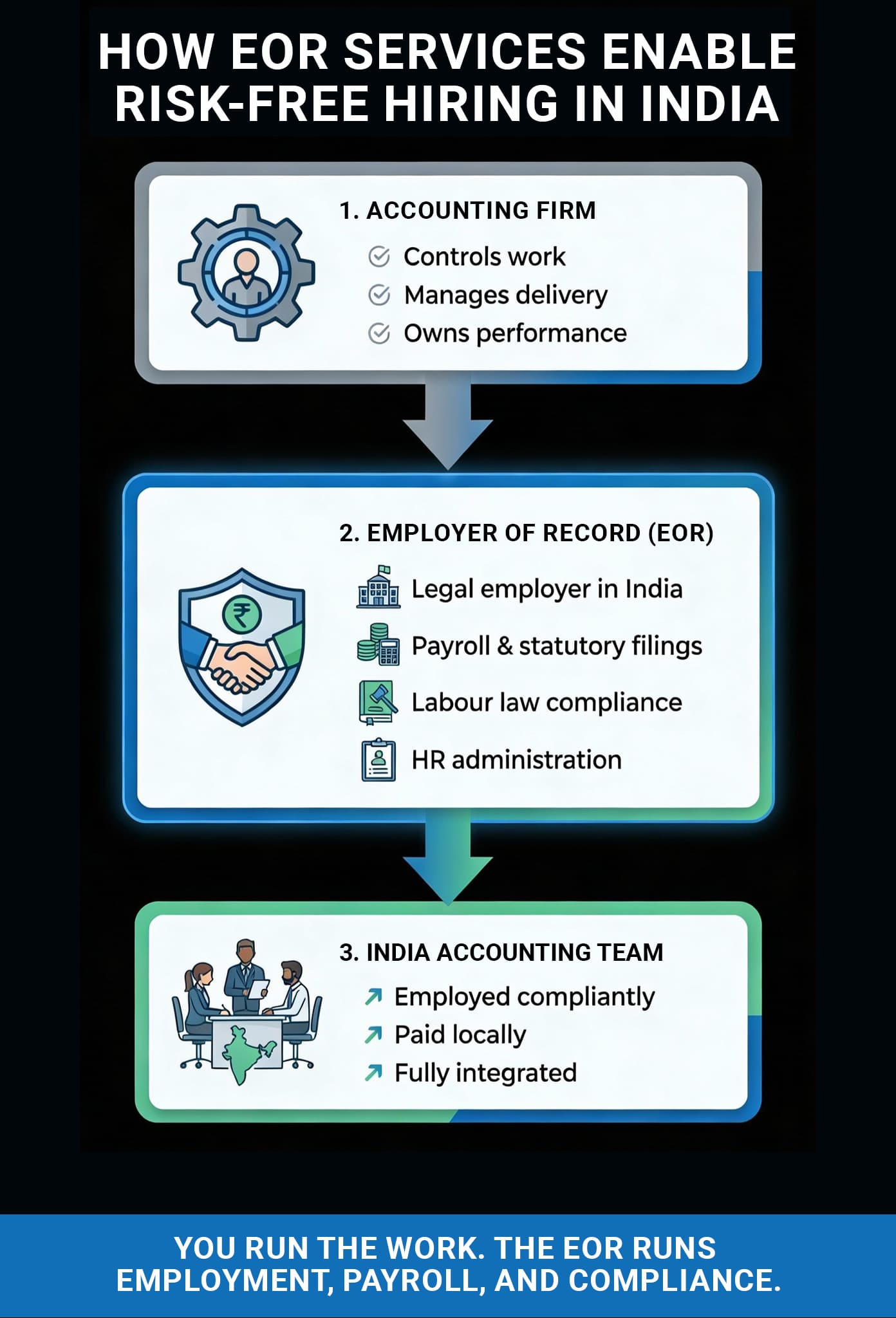
An Employer of Record (EOR) is a third-party organisation that legally employs workers on
behalf of another company in a foreign country. When firms hire in India using Employer of
Record (EOR) Services, the EOR becomes the legal employer under Indian law, while the firm
retains full control over day-to-day work, performance management, and client delivery.
This distinction is critical. The accounting firm directs what work is done and how it is delivered,
while the EOR assumes responsibility for how employment is structured and governed.
In practical terms, Employer of Record (EOR) Services in India typically cover:
- Drafting and maintaining India-compliant employment contracts
- Monthly payroll processing and salary disbursement
- Statutory tax deductions and filings, including income tax and social security contributions
- Administration of mandatory employee benefits
- Ongoing HR support and labour law compliance monitoring
- Compliant onboarding and offboarding processes
By working with experienced EOR Service Providers, firms avoid setting up a local entity or
building in-house expertise around Indian employment law. Compared to contractor models or
direct hiring, an EOR offers a structured, legally sound employment framework that reduces risk
while allowing firms to scale efficiently.
Why EOR Services Are Ideal for Accounting Firms
TAccounting firms do not just need additional headcount. They need capacity that holds up under regulatory scrutiny. Employer of Record Services for Accounting Firms align well with this reality because they address structural challenges rather than generic hiring issues.
1. Accounting Work Is Cyclical
Tax seasons, audits, and reporting deadlines create sharp workload spikes. EOR services allow firms to adjust capacity in India without committing to permanent infrastructure or long-term employment structures.
2. Compliance Risk Is Amplified in Accounting
Accounting firms operate under heightened scrutiny from regulators, clients, and professional bodies. Even a single payroll or employment compliance issue offshore can escalate quickly. By managing payroll and labor law compliance India centrally, EOR services reduce exposure in one of the highest-risk operational areas.
3. India Is a Mature Accounting Delivery Market
The global finance and accounting outsourcing market was valued at USD 54.79 billion in 2025 and is projected to reach USD 81.25 billion by 2030, reflecting sustained demand for scalable delivery models. India remains a core contributor to this growth due to talent depth and operational maturity.
4. Governance Matters More Than Cost at Scale
As offshore teams grow, informal hiring models begin to break down. Contractor arrangements, inconsistent contracts, and fragmented payroll processes become difficult to govern. EOR services replace ad-hoc approaches with a single, auditable employment framework.
5. Leadership Focus Stays on Clients
Partners and senior managers are not equipped to manage foreign employment regulations. EOR services remove this distraction, allowing leadership to focus on client delivery, quality control, and long-term growth.
EOR services are ideal for accounting firms not because they are faster or cheaper, but because they introduce structure, governance, and predictability into international hiring.
Planning to hire accounting teams in India but unsure how to
manage employment and compliance correctly?
Reach out NOW!
The Real Risks of Hiring Globally Without an EOR
Hiring across borders is no longer unusual for accounting firms. What often gets underestimated is that employment risk is local everywhere, even when the work itself is global. These risks do not usually appear on day one. They surface as teams grow, contracts are tested, or payroll and compliance come under review.
1. Worker Classification Is a Global Risk
Across countries, worker classification depends on how work is performed, not what the contract says. This applies in India, the UK, the EU, the US, and beyond.
Scenario
An accounting firm engaged offshore professionals as contractors across multiple countries, including India. The individuals worked fixed hours, reported to firm managers, and used internal systems. When one role ended and a dispute arose, the working relationship was reviewed locally and treated as employment.
Impact
Backdated statutory obligations and urgent restructuring of hiring models.
Why this matters
Misclassification is a core India hiring compliance for accounting firms risk, but it is equally relevant in markets governed by IR35 rules, EU employment protections, or US state labour laws.
2. Payroll Errors Are Jurisdiction-Specific and Often Found Late
Payroll rules vary significantly by country. Statutory deductions, employer contributions, and reporting timelines differ, and mistakes are rarely obvious during routine processing.
Scenario
A firm ran multi-country payroll using a centralised system without sufficient local expertise. Errors in statutory calculations were identified later during a compliance review.
Impact
Retroactive payroll corrections, penalties, and leadership time diverted to resolution.
Why this matters
Maintaining payroll and labor law compliance India, alongside other jurisdictions, requires localised handling rather than one global payroll model.
3. Employment Contracts Do Not Travel Well
Contracts drafted for one country often fail in another. Local labour laws dictate how notice periods, termination rights, and severance are enforced.
Scenario
An accounting firm reused standard contracts across regions, including India and parts of Europe. When exits occurred, several clauses were challenged as non-compliant.
Impact
Delayed exits, additional compensation, and legal complexity.
Why this matters
When firms hire accounting teams in India or elsewhere, contracts must reflect local legal standards, not global templates.
4. Risk Multiplies as Teams Scale Internationally
Informal hiring models may work for one or two hires. They rarely scale across countries.
Scenario
A firm expanded offshore teams gradually across multiple regions. Each hire followed slightly different employment terms and payroll processes. When leadership attempted to formalise governance, inconsistencies created delays and clean-up costs.
Why this matters
Without a consistent framework, international hiring becomes difficult to govern.
5. Employment Structure Impacts Governance and Reputation
Employment practices increasingly come under scrutiny during audits, client due diligence, and internal risk reviews.
Scenario
During a client review, an accounting firm was asked to explain how offshore staff were employed across jurisdictions. Documentation was inconsistent.
Impact
Additional scrutiny and internal concern around controls.
Why this matters
For accounting firms, employment governance is not just an HR issue. It directly affects trust and credibility.
The Global Pattern
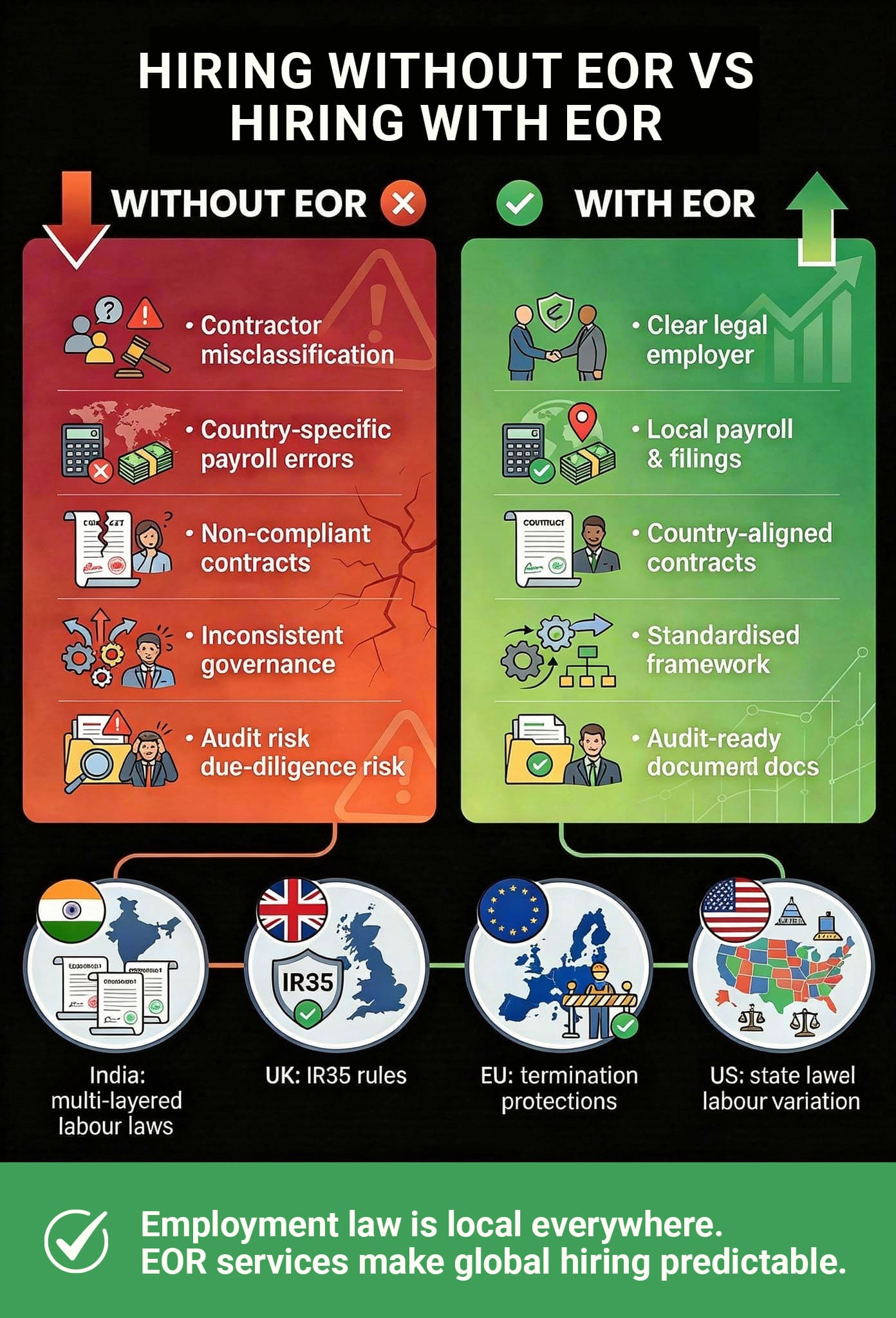
Across markets, the pattern is consistent. Employment law is local. Enforcement focuses on practice over labels. Informal hiring models do not scale.
This is why firms operating internationally rely on Employer of Record (EOR) Services and experienced EOR Service Providers. Employer of Record Services for Accounting Firms provide a compliant framework that adapts to local law while supporting global growth, including when firms hire accounting teams in India.
How EOR Services Reduce These Risks
As established earlier, hiring internationally is not inherently risky because teams are offshore. The risk comes from the fact that employment law, payroll rules, and labour enforcement are local in every country. India is a strong example of this complexity, but the same structural challenges exist across global markets.
Employer of Record (EOR) Services exist to manage these country-specific differences through a compliant, local employment framework that supports global growth.
1. Employment Law Is Fragmented Across Jurisdictions
Most countries do not operate under a single, uniform employment statute. Instead, obligations are spread across national, regional, and sometimes state or provincial laws. Requirements can vary based on role type, compensation structure, location, and industry.
In India, this fragmentation is particularly visible, with employment obligations governed by multiple central and state-level laws. Similar complexity exists across the EU, the US, and other regions.
Employer of Record (EOR) Services align employment terms with applicable local regulations from the outset, reducing the risk of unintended non-compliance as teams expand or operate across locations.
2. Payroll Is Statutory-Driven, Not Just Salary-Based
Globally, payroll is more than salary and income tax. Employers are responsible for statutory deductions, employer contributions, and mandatory filings, all governed by strict timelines that vary by country.
In India, payroll includes multiple statutory components that sit squarely with the employer. Similar employer-led obligations exist in many jurisdictions, though the rules and thresholds differ.
Experienced EOR Service Providers manage payroll locally, ensuring payroll and labor law compliance India and in other jurisdictions is handled accurately and consistently, rather than forcing a one-size-fits-all payroll model.
3. Employment Contracts Are Enforced Locally
Employment contracts do not travel well across borders. Clauses around notice periods, termination rights, severance, and benefits are interpreted and enforced under local law, not the law of the hiring company’s home country.
In India, contracts are actively examined during disputes and exits, and templates adapted from other regions often fail to reflect local enforcement standards.
Employer of Record Services ensure contracts are drafted and maintained in line with local legal standards, reducing exposure when exits, role changes, or disputes occur.
4. Classification Depends on Practice, Not Labels
Across jurisdictions, labour authorities focus on how work is actually performed. Long-term, supervised roles with fixed hours are likely to be treated as employment, regardless of whether individuals are labelled contractors.
This principle applies in India, under IR35 in the UK, across EU employment protections, and under state-level rules in the US.
By acting as the legal employer, Employer of Record (EOR) Services remove ambiguity around worker classification when firms build long-term teams, including when they hire accounting teams in India.
5. Compliance Risk Grows With Headcount
Employment risk does not scale linearly. Each additional hire increases reporting, documentation, and statutory obligations. Without a consistent framework, small inconsistencies accumulate and become difficult and costly to correct later.
Employer of Record Services for Accounting Firms apply a standardised employment structure from the first hire, enabling compliant growth without administrative sprawl.
Why Choose TOTL Advisors for EOR Services
The value of an Employer of Record partner lies not in global reach alone, but in understanding how regulated professional services firms operate across jurisdictions.
TOTL Advisorsprovides Employer of Record Services for Accounting Firms with a clear focus on governance, compliance, and delivery continuity.
1. Accounting-Firm–First Approach
TOTL Advisors works specifically with accounting and professional services firms. Its EOR framework is designed around audit cycles, tax-season pressures, confidentiality requirements, and consistent delivery standards, rather than generic global hiring models.
2. India-Specific Employment and Payroll Expertise
As an experienced EOR Service Provider, TOTL Advisors manages employment contracts, payroll processing, and statutory obligations in India through local compliance expertise. This enables firms to hire accounting teams in India and scale without building internal HR or legal capability for the region.
3. Governance, Transparency, and Documentation
TOTL Advisors maintains structured employment records, clear payroll reporting, and consistent documentation. This supports internal governance, client due diligence, and audit readiness.
4. Scalable Support Without Rework
Whether firms are making their first hire or expanding larger delivery teams, TOTL’s EOR model remains consistent. This allows firms to scale internationally without needing to revisit or rebuild employment structures as headcount grows.
Conclusion
Hiring in India can be a powerful strategy for accounting firms because India has become a major global hub for accounting and financial services — a trend already embraced by large international firms, including 90 % of Fortune 500 companies that use India for outsourced financial and accounting work. The global finance and accounting outsourcing market is also large and growing, valued at USD 54.79 billion in 2025 and projected to reach USD 81.25 billion by 2030 at an 8.21 % CAGR, reflecting broader demand for scalable, cost-efficient delivery.
Employer of Record (EOR) Services provide a structured way to hire accounting teams in India while managing the complexities of local employment law and statutory obligations. By partnering with experienced EOR Service Providers, firms can rely on Employer of Record Services for Accounting Firms to handle employment contracts, payroll processing, and ongoing compliance, reducing exposure to legal and administrative risk without needing to build in-house expertise in a foreign jurisdiction.
With this approach, firms can scale confidently, maintain governance and oversight, and focus on high-value work rather than employment administration — turning international hiring into a compliant, predictable growth strategy.
Looking for Employer of Record services that help your
accounting firm hire in India without risk?
Let's chat!








 USA
USA INDIA
INDIA